
NAICS 11251 Aquaculture.
This industry comprises establishments primarily engaged in the farm raising and production of aquatic animals or plants in controlled or selected aquatic environments. These establishments employ various forms of intervention in rearing to enhance production, including holding animals in captivity, regular stocking, feeding, and protection from predators, pests, and diseases.
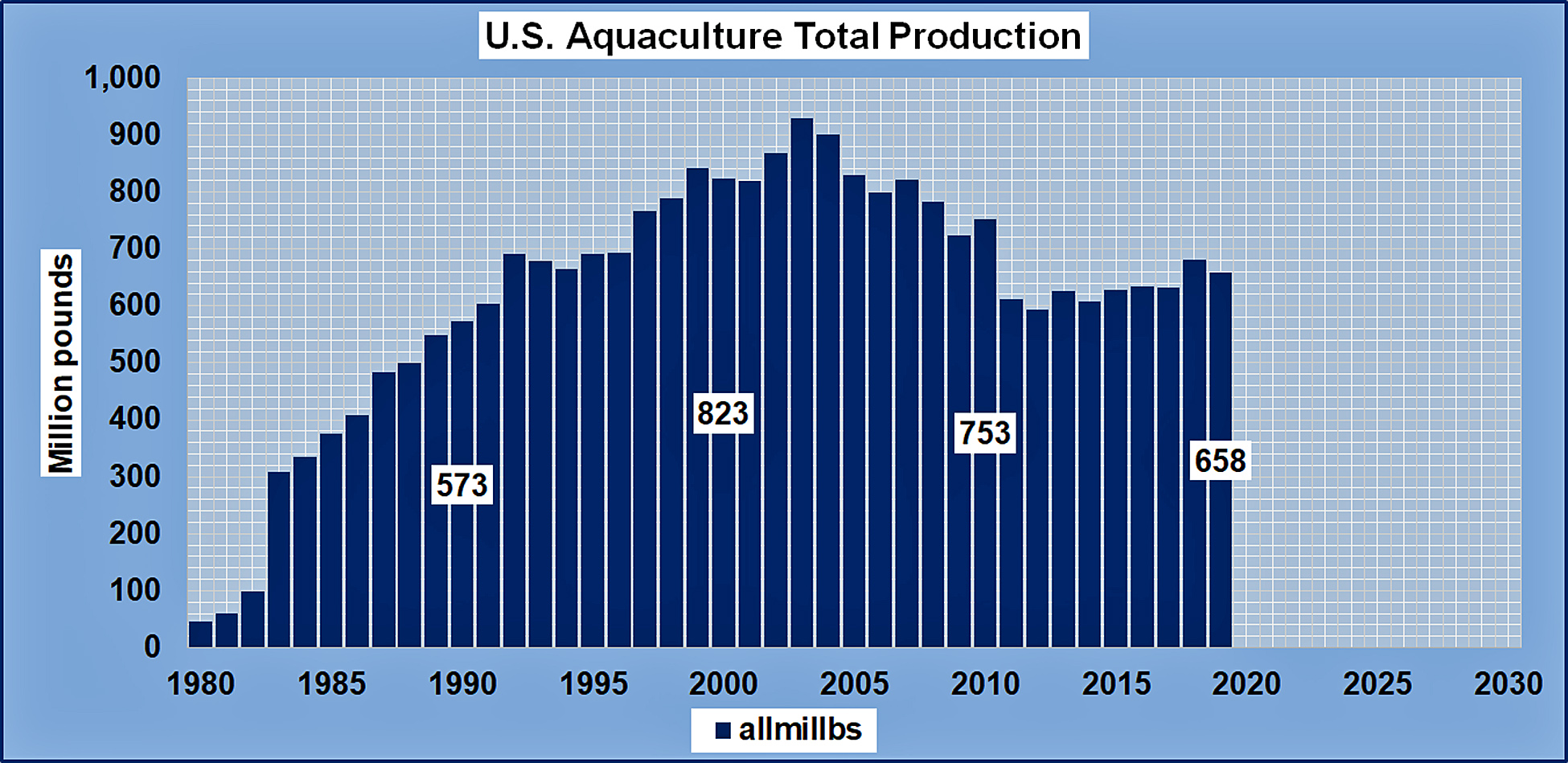
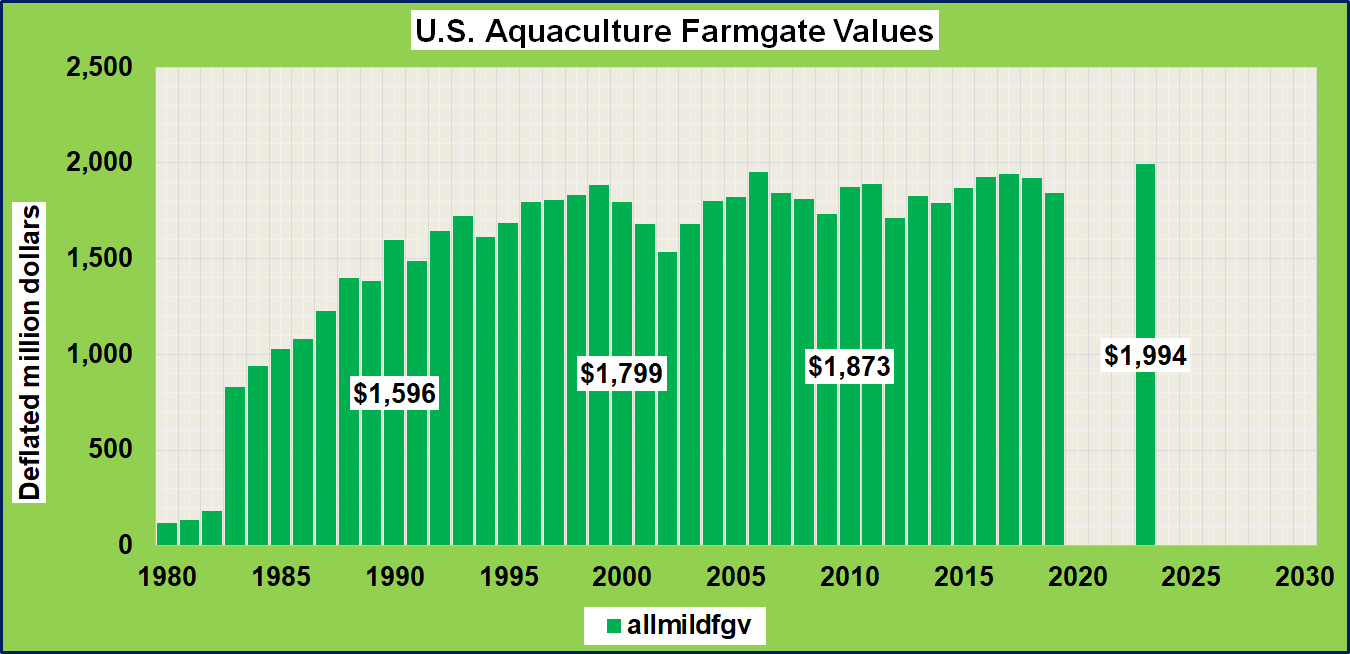
The total U.S. aquaculture production is the sum of all species produced in the United States. The raw data were compiled from the USDA Aquaculture reports since 1980. The data in later years were compiled from the NOAA Fisheries website. The most recent data reported by NOAA Fisheries ended in 2019, and the results of the USDA 2023 Census of Aquaculture.
The number of U.S. private aquaculture establishments rose from 737 in 2005, 806 in 2010, 850 in 2015, 928 in 2020, and 1,037 in 2025. U.S. private aquaculture production expanded from 573 M pounds in 1990 to 823 M pounds in 2000, but fell to 753 M pounds in 2010 and to 658 M pounds in 2019. The U.S. private aquaculture deflated farmgate values grew from $1.6 B in 1990, $1.8 B in 2000, $1.9 B in 2010, and $2.0 B in 2023.
Source of raw data: USDA Aquaculture Reports and NOAA Fisheries.
Legend: * - There are no official data beyond 2001 and the 2023 USDA Aquaculture Census.
More details at https://youtu.be/5PV_UgN8FRk.
The Quarterly Census of Employment and Wages (QCEW) program publishes a quarterly count of employment and wages reported by employers covering more than 95 percent of U.S. jobs, available at the county, MSA, state, and national levels by industry. The source of raw data on job numbers and wages is the Bureau of Labor Statistics website. The number of jobs includes only QCEW Employees. Non-QCEW Employees, Self-Employed Individuals, and Extended Proprietors are excluded.
The number of U.S. private aquaculture jobs rose from 5,886 in 2005, 5,908 in 2010, 6,454 in 2015, 6,912 in 2020, and 7,238 in 2025. The average U.S. private aquaculture deflated wages increased from $43,442 in 2005 to $44,663 in 2010, to $46,278 in 2015, to $53,640 in 2020, but fell to $52,670 in 2025.
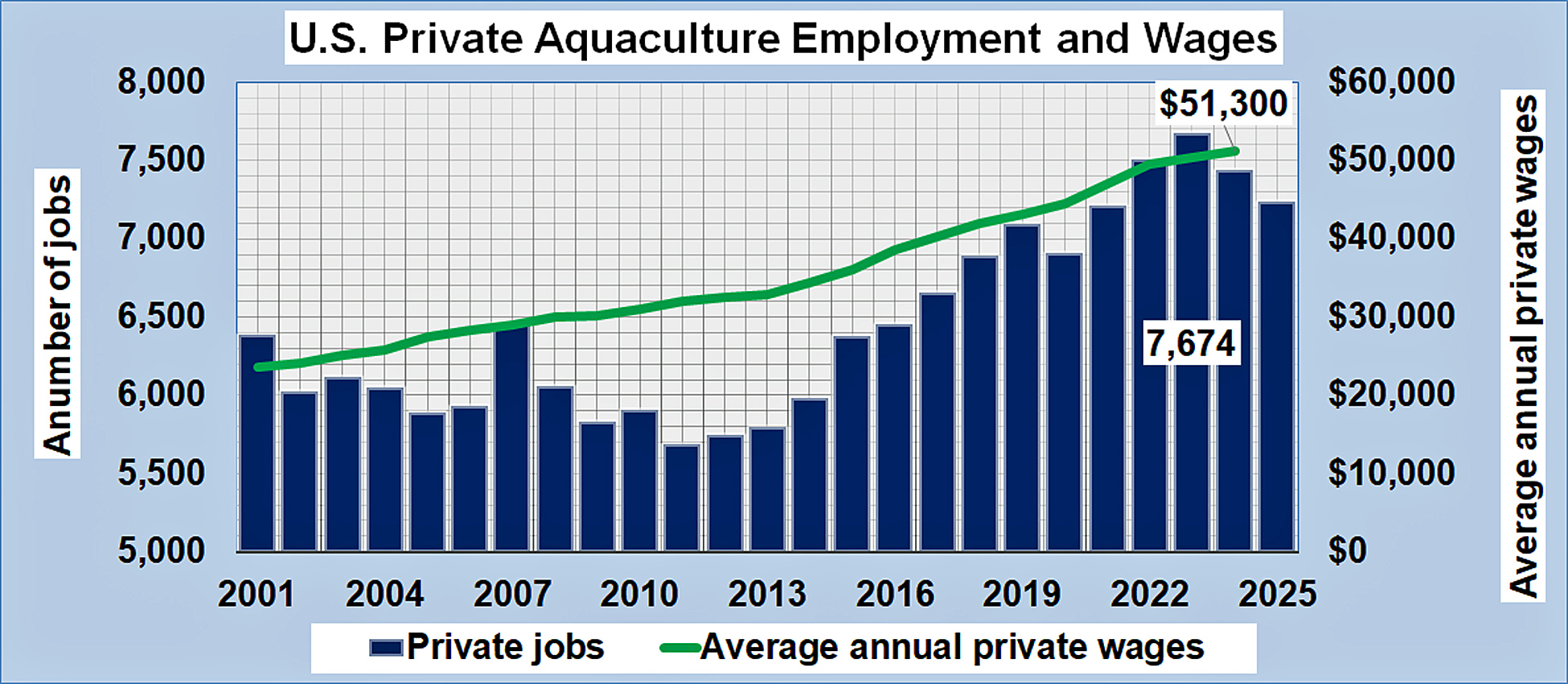
Source of raw data: Bureau of Labor Statistics. Employment only includes QCEW Employees. Non-QCEW Employees, Self-Employed Individuals, and Extended Proprietors are excluded due to a lack of data.
Legend: QCEW - Quarterly Census of Employment and Wages.
For more details about jobs and wages, please visit https://youtu.be/L_f57AgfVbE.
|