
Mississippi Seafood Industry
The seafood industry consists of commercial harvesting, seafood processing, seafood wholesaling, seafood and fish markets, and restaurant establishments.
-
Commercial harvesting or fishing includes finfish and shellfish fishing. It comprises commercial fishermen using various gears onboard large vessels and small boats.
-
Seafood processing primarily includes canning and fresh and frozen seafood processing. It involves plants engaged in primary wholesale and processing of seafood products.
-
Seafood importing was added to the seafood industry, starting in 2009. It comprises establishments that buy seafood products from countries of origin outside the United States.
-
Seafood wholesaling corresponds to fish and seafood merchant wholesalers. It includes secondary wholesale and processing of seafood products.
-
Seafood and fish markets correspond to the retail trade of fish and seafood products.
-
Seafood restaurants include the retail trade of seafood products by eating and drinking places.
Components of Economic Contributions
The total economic impact is the sum of direct, indirect, and induced impacts. Direct impacts reflect the economic effects within the sector where the expenditure was initially made. Indirect impacts arise from changes in the economic activity of other industrial sectors that supply goods or services to the sector under evaluation. Induced impacts result from personal consumption expenditures by industry employees.
Types of Economic Contributions
Income, value-added, and output impacts are expressed in dollars for the year specified by the user. Output or sales is the gross sales by businesses within the economic region affected by an activity. Labor income includes personal income, such as wages and salaries, and proprietors’ income, or income from self-employment. Employment impacts are expressed in terms of a mix of both full-time and part-time jobs.
Sales and Employment Contributions
The economic contributions of the entire Mississippi seafood industry since 2014 are shown in the figure below. There were significant declines in contribution levels resulting from Hurricane Katrina in 2005, the Deepwater Horizon oil spill in 2010, the opening of the Bonnet Carre Spillway in 2011 and 2019. The entire Mississippi seafood industry has generated an average of $287 million per year in economic contribution from 2014 to 2018. An average of 5,891 jobs were created in Mississippi by the whole seafood industry in the same period. Overall, the Mississippi seafood industry has not yet fully recovered from the 2019 disaster and the global pandemic.
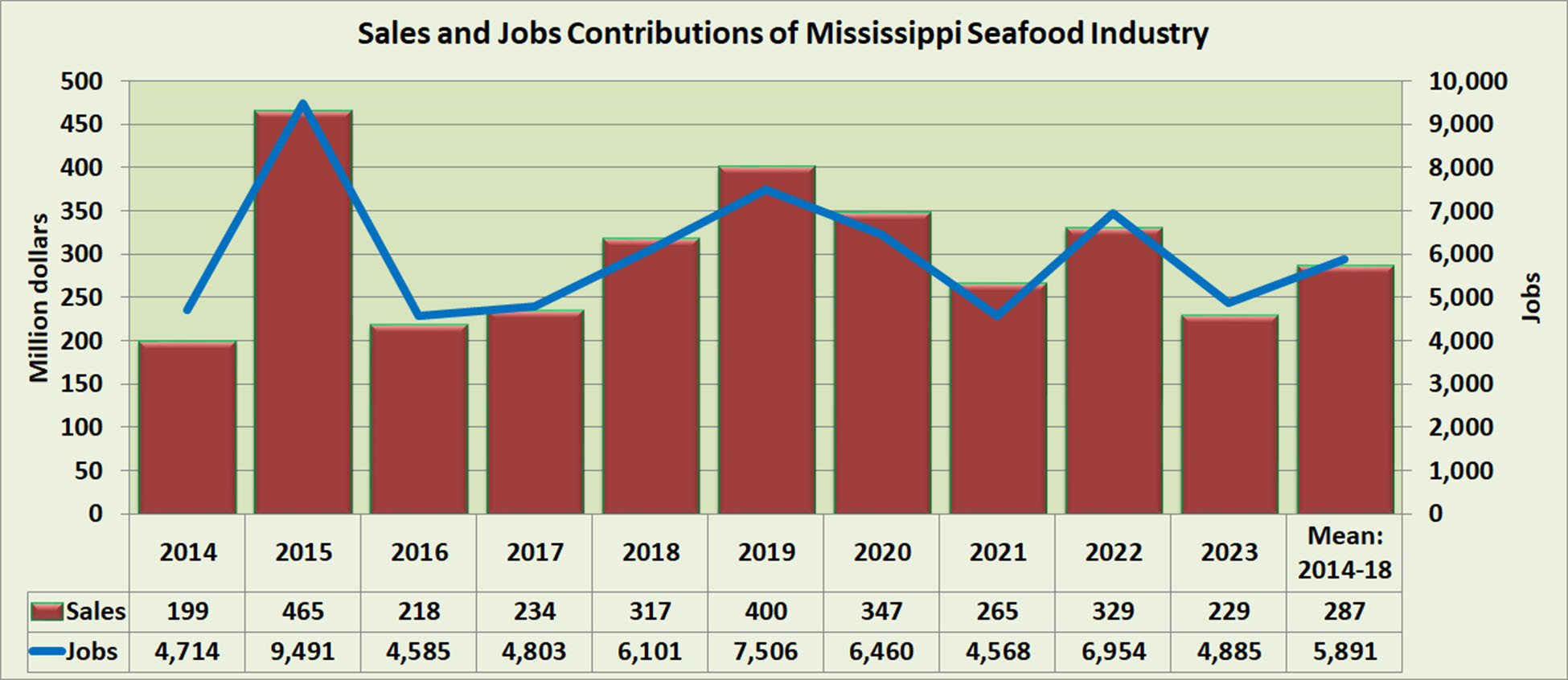
Figure 1. This figure shows the annual sales and job contributions of the entire Mississippi seafood industry since 2014. The source of raw data is NOAA Fisheries.
Sectoral Economic Contributions of Seafood Industry
Economic Contributions by Major Species
Links to the Economic Contributions in the U.S., Alabama, and Mississippi